Worked example
Force-feedback handwheel for a steering test bench
A steering wheel with a motor that pushes back with the feel your software sets.
Not a past job. This is how we would build it.
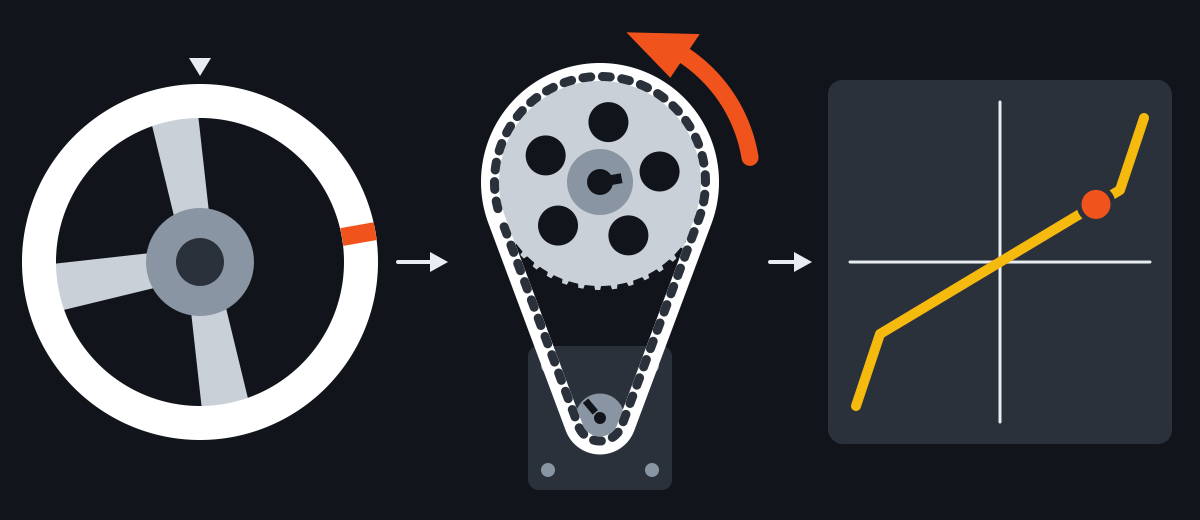
- The hand turns the wheel
- The motor pushes back
- Your software sets the feel
- Who it is for
- A tractor maker testing steer-by-wire feel before there is a vehicle.
- Mechanism
- Wheel shaft on two bearings, 4:1 toothed belt from a low-cogging brushless motor, travelling-nut end stop.
- Electronics
- STM32G4 motor drive, absolute encoder on the wheel shaft, 48 V supply, CAN.
- Firmware
- C, bare metal. Current loop at 20 kHz, feel loop at 2 kHz.
- Target
- 12 Nm peak, 6 Nm continuous, 1.5 turns each way.
The situation
Steer-by-wire removes the steering column and everything the driver felt through it. Engineers want real drivers to try different feels on a bench.
How we would build it
A shoebox-sized unit on a bench frame. Your wheel bolts to the hub; a motor below drives the shaft through a 4:1 belt. The PC sets the feel over CAN while a driver holds the wheel.
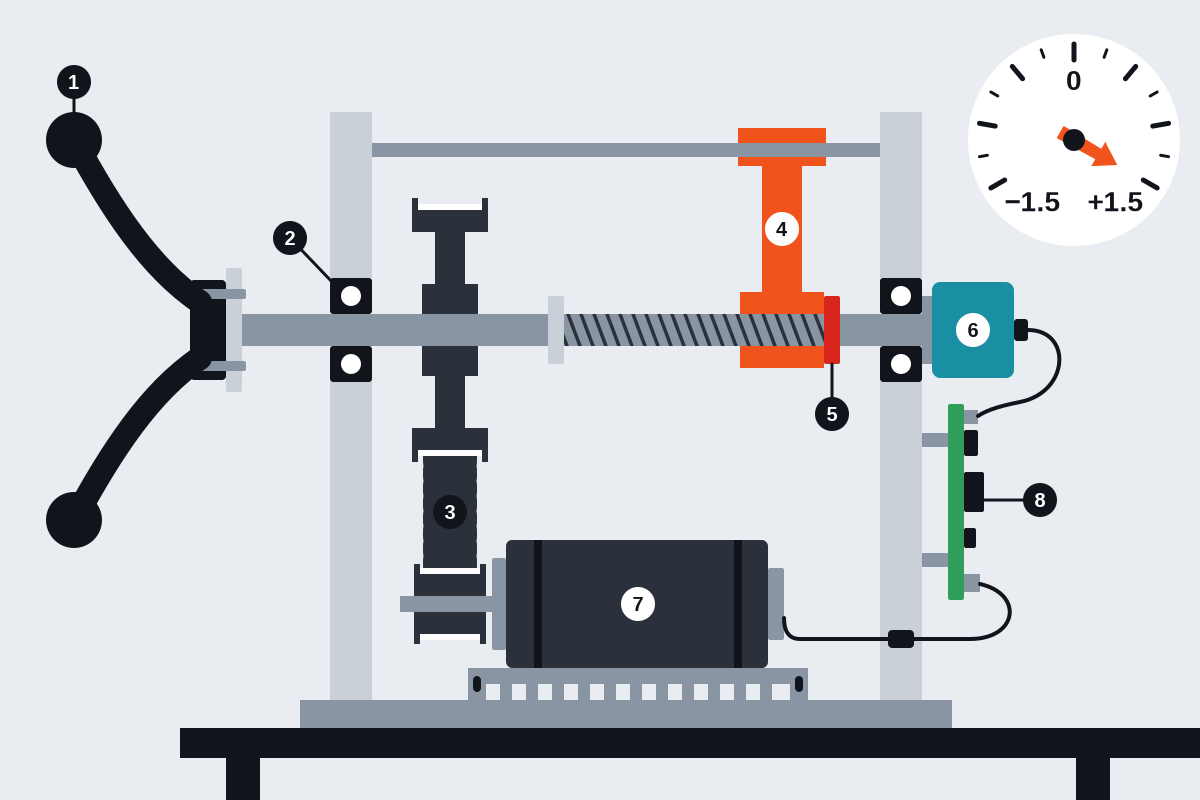
- Steering wheel
- Bearings
- Toothed pulley and 4:1 belt
- Travelling nut
- Stop shoulder
- Encoder on the wheel shaft
- Brushless motor on a finned mount
- Drive board
Design
Decisions that matter
Cogging you can feel
Cogging goes straight to the hands, and gears add backlash. So the reduction is a belt.
A stop that needs no firmware
If the board fails at 12 Nm, the nut still stops the wheel.
When the PC goes quiet
If CAN stops for 50 ms, the unit ramps to light damping. The emergency stop cuts motor power outside the firmware.
Heat at stall
Holding against a stop is a stalled motor. A winding thermistor derates it, and the finned mount takes the heat to the frame.
Handover
What you would get
- Two units on bench frames
- CAN document and a feel-editing tool
- Firmware source
- Drawings and STEP files
- Schematics, PCB files and BOM
- A calibration report per unit